


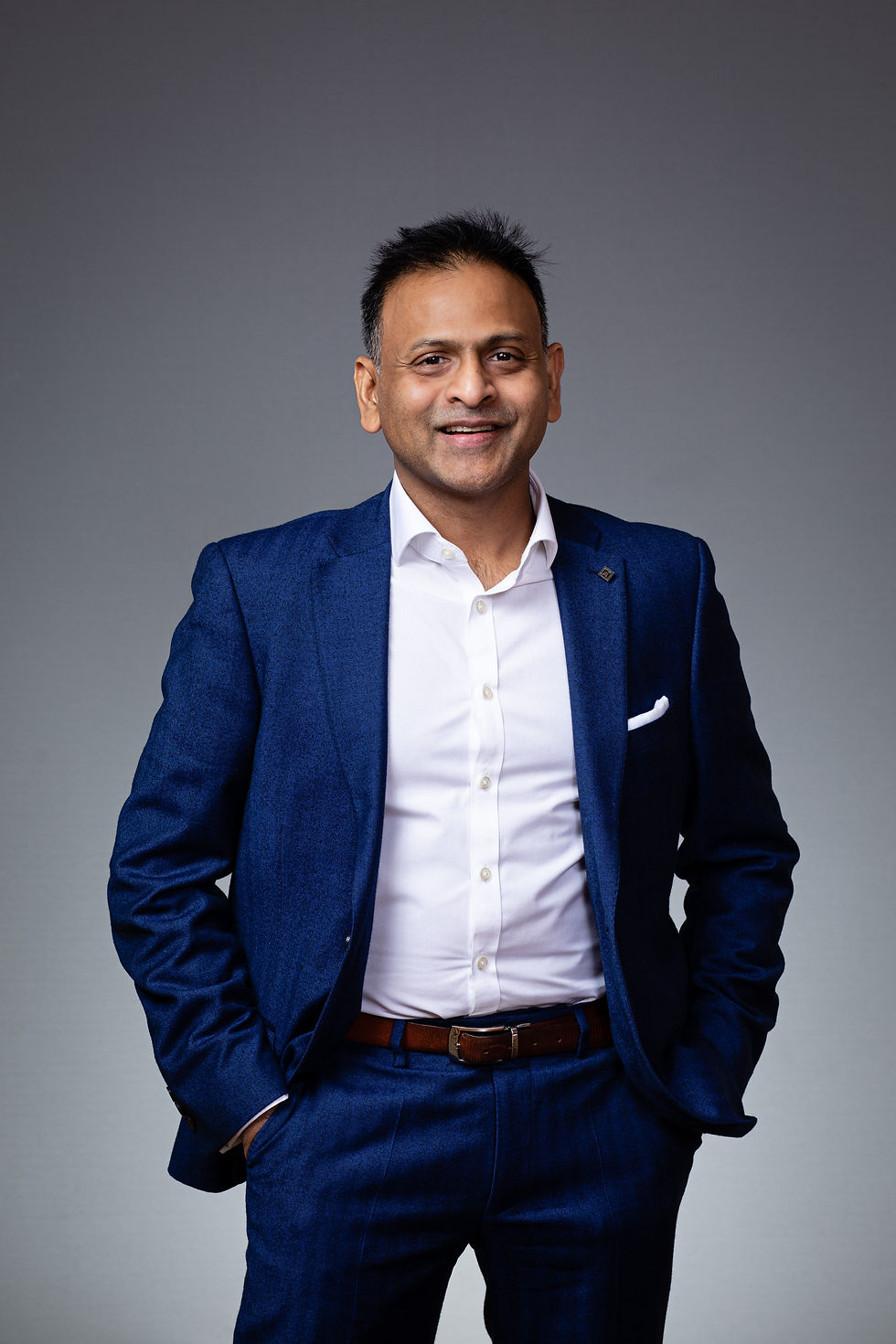
JEFF STARKE - Republic Bank
Updated: Oct 2

The Leader Who Shows Up: Jeff Starke's People-First Revolution in Banking Technology
How Republic Bank's EVP, CIO and COO is redefining what it means to lead through transparency, visible presence, and an unwavering belief that technology serves people, never the reverse.
Jeff Starke's office at Republic Bank sits at the far end of the floor from the restroom. It's an inconvenient location by most executive standards, but for Starke, it's perfect. The placement means he passes many people on his team multiple times a day, a deliberate architectural advantage for a leader who believes visibility isn't optional.

Shortly after joining Republic in 2021, Starke made a discovery that would fundamentally shape his leadership approach. Walking the floor one afternoon, he struck up a conversation with a longtime employee, someone who had been with the organisation for nineteen years. When Starke mentioned his predecessor, the employee looked puzzled. He had never met the previous CIO, couldn't identify him and didn't know what he looked like. "That moment crystallised everything for me," Starke recalls. "How can you lead people who don't even know who you are? How can you build trust, drive change, or create psychological safety when you're invisible?" The revelation sparked immediate action. Starke instituted monthly all-hands meetings where every member of his organisation can see him, hear directly from him, and ask questions in an open fifteen-minute Q&A session. He makes a point of stopping at desks, waving in hallways, learning names, and remembering details about people's lives. It's not performative leadership theatre. It's a fundamental belief that when people feel seen as human beings rather than resources or commodities, engagement rises exponentially.
"It is never about the technology until it is first about the people," Starke says, articulating the philosophy that guides every decision he makes. "When people feel you genuinely care about them as individuals, everything changes. They bring their best selves to work. They trust you during difficult transitions. They take ownership of outcomes."
This isn't the typical profile of a Chief Information Officer. But then again, Jeff Starke isn't a typical CIO.
The Accidental Technologist
Starke's path into technology leadership began not in computer science classrooms but in psychology lectures. His original undergraduate major reflected a deep fascination with people: how they think, what motivates them, how they process the world around them. It was a passion that would prove far more valuable to his eventual career than any coding bootcamp. "I loved understanding the human mind and human behaviour," Starke explains. "I still do. That foundation shapes everything about how I lead today."
But life has a way of redirecting even the most carefully laid plans. Marriage and the birth of his first child brought new responsibilities and the practical need for financial stability. Psychology, while intellectually fulfilling, didn't offer the immediate earning potential a young family required. Starke needed a pivot and found it through an unexpected connection.His father-in-law worked in technology, specifically in software development. Through that relationship, Starke landed his first technology job in a contact centre supporting online banking and bill pay for credit unions and banks. While working full-time, he enrolled in a two-year technical school programme focused on computer network systems, with heavy emphasis on hands-on lab work.
"It was eye-opening," Starke remembers. "I suddenly saw the potential of what technology could do in financial services. But more importantly, I saw how technology affected people: the customers trying to access their accounts, the employees trying to serve them, the organisations trying to grow." That dual lens, technology as tool, people as purpose, would become his signature approach. But first, he needed to learn some hard lessons about organisational dynamics. Early in his career, Starke was promoted into a new role and immediately identified an opportunity to move into networking, a position that better aligned with his skills and the company's needs. Company policy, however, was rigid: employees had to remain in a promoted position for twelve months before transferring. The rule existed to prevent "promotion hopping," but it made no allowance for common sense or business context.
Frustrated by the inflexibility, Starke resigned. Three days later, the company called back, offering him an interview for a position in another state. He got the job, but the company had to restore his service time to make the transfer work, a bureaucratic exercise that benefited no one and cost the organisation both time and goodwill. "That experience taught me about what I now call 'structured fluidity,'" Starke explains. "You need policies that provide guardrails and protect the organisation, but you also need room for common sense and the best business decision in context. Overly prescriptive rules that don't allow for human judgment create more problems than they solve." It's a principle he would carry forward through every leadership role that followed, particularly during the most formative period of his career.

The Crucible: Fourteen Acquisitions and the Power of Transparency
When Jeff Starke joined Bank OZK, the institution held $2.4 billion in assets. Over the next eleven and a half years, he would lead technology through fourteen acquisitions as the bank grew to nearly $30 billion. It was a period of relentless change, constant integration, and acute employee anxiety, particularly in the post-2008 financial collapse context where banking jobs felt perpetually precarious. Starke came to Bank OZK through an acquisition, an experience that gave him profound empathy for what acquired employees face: uncertainty about their roles, fear about cultural fit, and anxiety about whether their skills and contributions will still matter in the new organisation.
"When you're going through an acquisition, everything feels unstable," Starke says. "People are nervous about their jobs, their teams, their futures. And the natural instinct in the executive suite is often to restrict information until everything is finalised and certain."
But Starke learned a different approach from his father, a printer who served on his company's leadership team. His father had a maxim that stuck with Jeff throughout his career: "What people aren't in on and up on, they are down on and out on."
The wisdom is deceptively simple but profoundly powerful. When leaders withhold information, even difficult or uncertain information, they create a vacuum that fills with speculation, rumour, and fear. When they share transparently, even when the news is scary or the path forward unclear, they build trust and create space for people to process change constructively.
"I made a commitment that unless something was illegal or unethical to share, I would be transparent with my teams," Starke explains. "That meant sometimes sharing information that was uncomfortable or incomplete. It meant admitting when I didn't have all the answers. But it also meant people knew I respected them enough to tell them the truth."
The approach transformed how his teams navigated the constant churn of acquisitions. Instead of rumour mills and waves of resignations, Starke built organisations where people felt informed, valued, and equipped to adapt. But transparency alone wasn't enough. It had to be paired with visible, active leadership.
During technology implementations and system conversions, the kind that happen at midnight on weekends when most executives are home with their families, Starke made it a point to be in the room. Not to supervise or micromanage, but to be present alongside his teams, ready to provide immediate support if something went wrong.
"Leaders need to show up," Starke says firmly. "Not to watch people work, but to be the hardest worker in the room. When your team sees you're willing to be there at midnight, willing to roll up your sleeves, willing to do the difficult work alongside them, that builds trust in a way no memo or speech ever could."
It's a philosophy rooted in his father's example. His dad would walk the production floor, stop at every station, know every employee's name, ask about their families. He was visible, accessible, and genuinely interested in the people who made the business run.
"My father showed me that leadership isn't about the corner office or the title on your business card," Starke reflects. "It's about showing people you care more about their effort and well-being than your own comfort or status." Those principles- transparency, visibility, and genuine care- would become the foundation of everything Starke built at his next stop, Republic Bank.

Expanding the Mandate: When Technology Meets Operations
Republic Bank hired Jeff Starke in 2021 as Chief Information Officer, seeking a strong technologist with deep banking experience. What they discovered was something more valuable: a people leader who understood how to integrate technology strategy with business outcomes and organisational health. Starke began by doing what he always does, building relationships beyond his immediate domain. He sought out market presidents, banking centre associates, and operational leaders, asking not just about technology challenges but about business-process pain points and client experience gaps. "I wanted to understand the real problems people were trying to solve," Starke explains. "Not what technology they thought they needed, but what they were trying to accomplish for clients and why current processes weren't working."
Several years into his tenure, Republic's leadership asked Starke to expand his role beyond CIO to include responsibility for back-office and operational functions, adding Chief Operating Officer to his title. For Starke, it was a game-changing opportunity.
"When you separate technology from operations, you create silos," he explains. "Technology makes decisions without fully understanding operational impact. Operations requests technology without understanding technical constraints or possibilities. Bringing them together enables something powerful: you can work backwards from the client experience, through the operational processes, all the way to the technology requirements."
"Trace3 has proven to be an exceptional partner. When I joined Republic, I initially challenged the value of the relationship and set high expectations for the team. They responded by consistently demonstrating their commitment, expertise, and willingness to invest in understanding our company, culture, and objectives. Over time, they have earned our trust and become a true extension of our team, helping us make informed decisions that deliver the best outcomes and value for both Republic and our clients."
- Jeff Starke
It's an approach Starke calls "client-led transformation," and it fundamentally reorients how technology decisions get made. Instead of asking "What's the coolest new technology?" or "What are our competitors doing?", the questions become "What does our client need?" and "What business problem are we actually solving?"
"’We’ is greater than me. When leadership understands that organisational health depends on collective good over individual positioning, you can make decisions that serve associates and clients regardless of organisational chart implications.” This philosophy aligns perfectly with Republic Bank's broader leadership culture, which Starke describes as "we is greater than me." It's an understanding that organisational health depends on collective good over individual positioning, a principle that enables making decisions that serve associates and clients even when they might blur traditional organisational boundaries.
"We reject technology for technology's sake," Starke says emphatically. "Innovation has to solve real business problems. It has to make life better for our clients, easier for our associates, or stronger for our community. If it doesn't do one of those things, we're not interested, no matter how cutting-edge or trendy it might be." This pragmatic, purpose-driven approach to innovation doesn't mean Republic avoids bold moves. It means they make them thoughtfully, with a clear understanding of why they matter and how they'll be supported.

The Innovation Paradox: Moving Fast While Staying Secure
One of the most delicate balances in modern banking technology is the natural tension between innovation and security. As CIO, Starke's mandate is to move the organisation forward, embrace new capabilities, and meet evolving client expectations. Meanwhile, the Chief Information Security Officer's responsibility is to protect the institution, mitigate risk, and ensure regulatory compliance. "There's inherent friction between those goals," Starke acknowledges. "And that's actually healthy. The key is building a partnership that truly hears both perspectives and iterates toward solutions that honour both imperatives."
When security requirements drive a decision, Starke and his CISO partner identify where those requirements create friction for clients or associates, then explore mitigation strategies and compensating controls. When innovation drives, they identify necessary security controls and work to implement them in ways that minimise user friction while maintaining protection.
"It's not about one side winning," Starke explains. "It's about finding the balance that keeps us secure while still enabling progress. Sometimes that means accepting more friction than we'd like. Sometimes it means implementing compensating controls that add complexity on the backend to preserve simplicity on the frontend." The approach requires deep listening, mutual respect, and shared commitment to the organisation's wellbeing over departmental territory. It's another expression of "we is greater than me", and it produces results that neither function could achieve alone.
Perhaps the most visible example of this balanced approach came with Republic's recent conversion to the Fiserv DNA core banking system, a foundational technology shift that touches every aspect of how the bank operates. "Core conversions are notoriously risky," Starke notes. "They're the technology equivalent of replacing the engine on an aeroplane while it's flying. Everything has to work perfectly because our clients are counting on us for access to their money, money they need for groceries, for gas to get to work, for their children's needs." The stakes couldn't be higher. Banking isn't a convenience; for most people, it's a necessity that enables every other aspect of their lives. Stability, therefore, isn't just a priority. It's job number one. Republic's conversion to Fiserv DNA was executed without outages or system failures post-go-live. It was a testament to partnership quality, meticulous planning, care for clients and community, and the wisdom of choosing partners well.
"That conversion exemplified everything we believe about how to approach major technology change," Starke reflects. "It required security and innovation working in lockstep. It required transparency with our teams about what we were doing and why. It required visible leadership during the critical moments. And it required never losing sight of the fact that real people depend on these systems working." “Our team was up to the challenge, and Fiserv as our partner was with us step for step all the way through.”
Strategic Partnerships: Choosing Vendors Who Share Your Values
For Jeff Starke, technology vendors aren't just suppliers. They're strategic partners whose values and approach must align with Republic's commitment to clients, associates, and community. The relationships he's built exemplify what he looks for: transparency, listening, and outcome-focused collaboration. Candescent, which provides Republic's consumer online and mobile banking platform, represents the partnership model Starke values most. These technologies serve as the 24/7/365 bridge between clients and their finances, arguably the most critical touchpoint in modern banking. "What sets Candescent apart is their transparency," Starke explains. "They provide clear roadmaps so we know what's coming. They've established executive advisory committees where they genuinely listen to clients and use that feedback to shape platform evolution. They're not just selling us software; they're partnering with us to serve our clients better."
Another strategic technology investment is Dynamic Experience Groups, which enables Republic to customise banking experiences for different client demographics without alienating core customers. It's a solution to a real operational challenge: how do you attract younger, digitally-native clients while preserving the experience that longtime customers value?

"Dynamic Experience allows us to grow without forcing unwanted change on our existing customer base," Starke notes. "It solves a genuine business problem, competing client experience needs, rather than just adding technology for its own sake."
Perhaps the most telling partnership story involves SHI, a technology vendor. Starke first worked with SHI during his Bank OZK tenure, finding the right Microsoft licensing and purchasing model for that institution's needs. When he joined Republic, SHI wasn't an existing partner, but Starke quickly identified that Republic needed better access to Microsoft and other technologies. "What impressed me about SHI was their approach," Starke recalls. "They didn't just ask what we wanted to buy. They asked why. They wanted to understand what we were trying to accomplish, what business outcomes we needed, what challenges we were facing. Then they proposed a package that aligned to those outcomes rather than just selling us the most expensive option."
It's an outcome-led partnership model that Starke believes should be standard but finds surprisingly rare. Too many vendors lead with product features rather than client needs. The best partners, he's learned, listen first and propose second. But even the best technology partnerships can't solve problems that aren't actually technology problems, a lesson Republic learned through client feedback about ATM fees. Net Promoter Score comments revealed that clients were paying foreign ATM fees despite having access to Republic's network of more than 90,000 fee-free ATMs nationwide. The technology existed. The benefit was real. But there was a communication gap.
"We realised we had an education problem, not a technology problem," Starke explains. "So we began proactively contacting clients whenever we saw a foreign ATM fee on their account. We'd explain the fee-free alternative, show them where nearby fee-free ATMs were located, and help them understand how to avoid those charges in the future."
Republic also engaged social media influencers to spread awareness about the fee-free network. The choice remains with clients. They can still use any ATM they want, but now they're making informed decisions rather than paying fees out of ignorance.
"That's what client-centric problem solving looks like," Starke says. "We didn't build new technology. We didn't create a flashy app feature. We communicated better and educated proactively. Sometimes the best innovation is just caring enough to help people understand what's already available to them."
This kind of insight comes from robust listening infrastructure. Republic uses Net Promoter Score feedback, satisfaction surveys, banking centre input, interactive teller machine data, and contact centre intelligence. But perhaps most valuably, they hold quarterly in-bank meetings where executives, including technology leaders, hear directly from frontline bankers about real operational pain points.
"Technology leaders cannot sit in the back office and make decisions in a vacuum," Starke insists. "We have to visit banking centres, talk to the people serving clients every day, understand their challenges firsthand. That's how you ensure technology decisions are grounded in reality rather than theory."
The Human Algorithm: Why People Always Come First
Every other month, Jeff Starke stands before his entire organisation for an all-hands meeting. He shares updates, celebrates wins, acknowledges challenges, and then opens the floor for fifteen minutes of unfiltered Q&A. Any question. Any topic. No preparation required. "Those fifteen minutes are sacred," Starke says. "They build psychological safety. When people know they can ask anything and get an honest answer, even if that answer is 'I don't know yet', it changes the entire dynamic of how they engage with leadership and with change." It's part of a broader philosophy that Starke articulates simply but powerfully: "It is never about the technology until it is first about the people."
He's learned that when people feel genuinely seen and valued as human beings, not as resources, not as commodities, not as line items on an org chart, their engagement rises exponentially. They bring discretionary effort. They take ownership of outcomes. They trust leadership during difficult transitions. "I make it a point to stop at people's desks, to wave in hallways, to remember names and details about their lives," Starke explains. "Not because it's a leadership technique I read in a book, but because I genuinely care about them as individuals. And when people feel that care is authentic, everything changes."
This isn't soft leadership or feel-good management theory. It's a pragmatic recognition that in knowledge work, and especially in technology, human engagement is the primary driver of outcomes. The best architecture, the most sophisticated algorithms, the most cutting-edge platforms mean nothing if the people implementing and supporting them aren't fully invested.
Starke's psychology background resurfaces here, informing his understanding of motivation, trust, and human behaviour under stress. He knows that people don't resist change itself. They resist feeling powerless or uninformed during change. They don't fear technology. They fear being replaced by it or diminished by their inability to master it.
"When you lead with transparency, when you show up visibly and consistently, when you demonstrate that you care about people's well-being and success, you create the conditions where change becomes possible," Starke reflects. "Not easy, necessarily, but possible. And that's what leadership is really about: creating the conditions for people to do their best work and reach their potential." It's a philosophy that extends beyond Republic's walls into the broader community the bank serves.
Service as Strategy: Leading Beyond the Balance Sheet
Jeff Starke serves on the boards of two Louisville organisations: Home of the Innocents, which serves children in crisis, and The Centre for Women and Families, where he serves as board chair. These aren't ceremonial positions or networking opportunities. They're substantive leadership roles where Starke contributes strategic thinking, operational expertise, and genuine commitment. He first encountered Home of the Innocents through Republic's existing relationship with the organisation. After meeting the CEO and learning about their mission and work, Starke was deeply impressed. He joined their technology committee, then later joined the board while continuing to serve on the committee.
"What struck me was how much these organisations accomplish with limited resources," Starke recalls. "Every dollar has to stretch further. Every decision has to be strategic. The opportunity to contribute thought leadership and operational expertise, not just financial support, makes a real difference." His involvement with The Centre for Women and Families came through a referral from a former Republic employee. After joining the board, Starke eventually became board chair, a role he describes with genuine enthusiasm: "I absolutely love the work and the contribution I'm able to make there."
What makes these commitments possible, and what makes them meaningful, is Republic Bank's explicit support for community engagement. Board meetings, fundraisers, and events are treated as part of Starke's role, not as time away from it. Every Republic associate receives paid volunteer time off, separate from other leave.
"When we say our mission is to help our community thrive, those aren't just words in a mission statement," Starke emphasises. "They're actions we take seriously every day. Community banks have a responsibility to care for the communities they serve, not just through financial products but through direct involvement and leadership." It's another expression of the "people first" philosophy that guides everything Starke does. Whether it's an employee seeking career guidance, a client navigating financial challenges, or a nonprofit organisation serving vulnerable populations, the approach is the same: listen deeply, understand what matters to them, and help them accomplish their goals.
Legacy in Action:The Measure of a Leader
When asked about his proudest accomplishment across a career spanning technical specialist, enterprise leader, team builder, philanthropist, and C-suite executive, Jeff Starke doesn't mention a system implementation or an acquisition integration or a technology innovation. "What I'm most proud of is having the opportunity and ability to help other people accomplish things that are meaningful to them," he says. "It's why I get out of bed and give everything I do 100 per cent." For Starke, the most fulfilling moments come from listening to another human being, understanding their goals and motivations, and helping them reach important milestones. The work and effort belong to them. He provides guidance, support, and sometimes removes obstacles. "It's not about technology," Starke reflects. "It's not about titles. It's not about compensation. It's about improving the world by helping other people realise their dreams."
It's a philosophy that circles back to that moment early in his tenure at Republic, when he discovered that a nineteen-year employee had never met his predecessor. That discovery crystallised a fundamental truth: you cannot lead people who don't know you exist. You cannot build trust from a distance. You cannot create meaningful change without meaningful relationships. So Starke walks the floor. He stops at desks. He holds all-hands meetings with open Q&A. He shows up at midnight during system conversions. He shares information transparently, even when it's uncomfortable. He listens to frontline bankers in quarterly meetings. He serves on nonprofit boards. He works backwards from client needs to technology solutions. "It's not about technology. It's not about titles. It's not about compensation. It's about improving the world by helping other people realise their dreams.
All of it flows from a single, unwavering conviction: technology serves people, never the reverse. When you get that relationship right, when you put people first in every decision, every strategy, every interaction, everything else follows.
In an industry often criticised for losing touch with the human beings it serves, Jeff Starke represents a different model: the leader who shows up, listens first, and measures success not by systems deployed or efficiency gained, but by people helped and potential realised. It's a revolution hiding in plain sight, happening one conversation, one relationship, one act of visible leadership at a time. And it's changing what's possible when technology, operations, and humanity work in service of each other rather than in competition.
The office at the far end of the floor, inconveniently distant from the restroom, turns out to be positioned perfectly after all. Because every walk down that hallway is an opportunity to see someone, to be seen, to build the trust that makes everything else possible. That's not just good leadership. It's leadership that matters.


Comments